Published
by Rogers Corporation
Elastomeric Material Solutions
Sustainability is becoming a common part of material selection conversations, but performance and reliability remain non-negotiable for engineers. The challenge is that many materials positioned as “sustainable” struggle to deliver the durability, consistency, and long-term performance required in real-world designs.
PORON® ReSource30 polyurethane foam was developed to address that challenge. Built on the proven performance of PORON® 30-grade polyurethane foam, PORON ReSource30 incorporates recycled and bio-based content to support sustainability goals while maintaining the performance characteristics engineers expect from PORON® materials.
To better understand the thinking behind PORON ReSource30 foam, we spoke with Justin Chretien, Product Line Manager, Global Polyurethanes at Rogers, about why the material was developed, what stayed the same, and how engineers should approach specifying it.
Justin Chretien – Product Line Manager, Global Polyurethanes
We developed PORON ReSource30 in response to OEMs asking for materials that support sustainability goals and climate pledges but do not sacrifice long-term performance. Engineers were clear — they wanted the same PORON reliability, but with a stronger sustainability story behind it.
PORON ReSource30 material was created to offer a more sustainable option within the PORON portfolio while maintaining the core mechanical and long-term performance characteristics engineers rely on from PORON 30-grade materials.
The goal was simple: reduce material carbon impact without changing how the material behaves in real applications.
From a performance standpoint, PORON ReSource30 foam is designed to behave like PORON 30 foam. That was a critical requirement from the start. Engineers choose PORON materials because of their long-term compression set resistance, low stress relaxation, and consistency over time.
PORON ReSource30 polyurethane maintains comparable compression force deflection (CFD), compression set, elevated temperature compression set, and stress relaxation performance aligned with PORON 30-grade polyurethane materials.
As Justin puts it, “It’s the same PORON 30 performance profile engineers know and trust, now with sustainable characteristics.”
The difference is in the formulation. PORON ReSource30 material incorporates recycled and bio-based content, contributing to a lower cradle-to-gate carbon footprint compared to standard PORON material of the same grade.
Not at all.
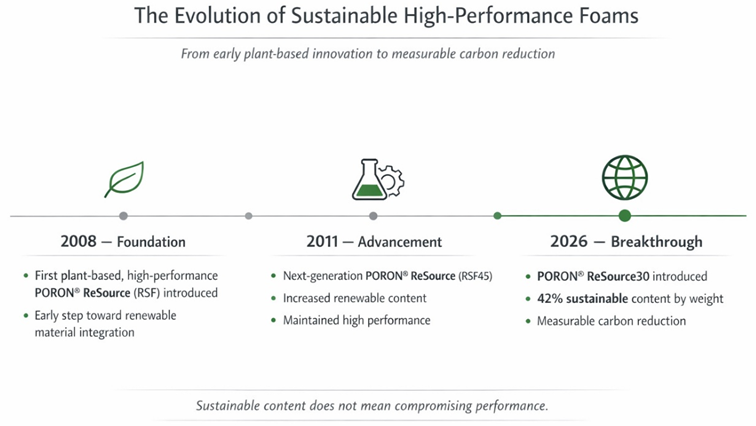
Rogers has been innovating sustainable polyurethane systems for more than a decade.
As Justin explains, earlier efforts were ahead of the market:
“We’ve explored sustainable polyurethane systems before. In some cases, we were early — the market wasn’t quite ready, and the cost structure made broad adoption difficult.”
Today, the landscape has changed. Sustainability has shifted from an often niche interest to a design requirement, as advances in formulation science now allow significantly higher sustainable content while maintaining performance parity.
PORON ReSource30 polyurethane builds on that foundation, aligning improved technology with market timing.
That was one of the biggest challenges. It is easier to introduce sustainable content if you are willing to accept compromises, but that was not an option here.
After all, a material that degrades prematurely or requires frequent replacement introduces additional waste and lifecycle impact. Long-term durability is a critical part of sustainability.
A foam that does not last as long would not be considered a truly sustainable solution.
Our development effort focused on maintaining the mechanical integrity and long-term performance that define PORON materials. PORON ReSource30 foam underwent the same rigorous internal evaluation processes applied across the PORON portfolio to ensure it meets durability, consistency, and reliability expectations.
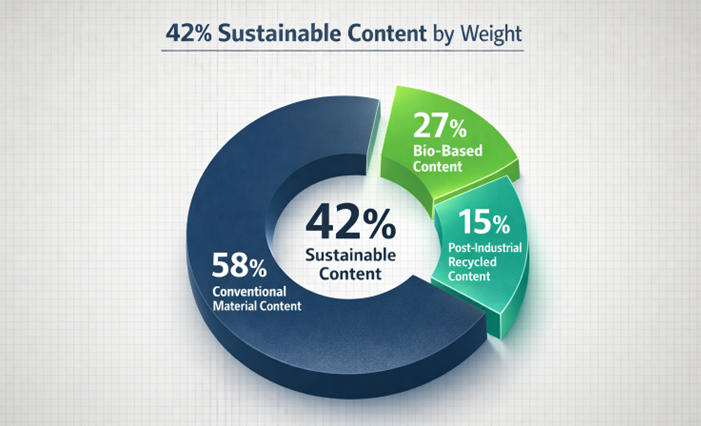
For Rogers, sustainability must be measurable and credible. PORON ReSource30 foam contains 42% sustainable content by weight, including:
Carbon footprint reduction is supported through cradle-to-gate life cycle assessment aligned with recognized methodologies (IPCC 2013 GWP 100a). In addition, bio-based content has been verified through third-party biogenic carbon testing using ASTM D6866-24 Method B, confirming the presence of plant-derived carbon in the formulation.
By grounding sustainability in measurable data rather than broad claims, PORON ReSource30 foam allows engineering teams to align material selection with evolving corporate and regulatory expectations.
At the same time, PORON ReSource 30 is not positioned as a universal solution. It is a performance-driven material option that also supports sustainability objectives.
PORON ReSource30 foam is a strong fit anywhere engineers are already using PORON 30-grade materials and want to introduce sustainability considerations without redesigning their system.
That includes applications such as:
Common target markets include consumer and portable electronics, automotive, industrial equipment, and enclosure designs, especially where OEM climate commitments are influencing material selection decisions.
Engineers can evaluate PORON ReSource30 material using the same design principles and testing approaches they already apply to other PORON materials.
Not necessarily.
PORON ReSource30 material expands the PORON product portfolio, but it does not replace it. Standard PORON materials remain critical depending on application requirements. PORON ReSource30 foam provides an additional specification option when sustainability becomes part of the design criteria.
Start with samples and technical data. From there, Rogers Sales Engineers and Technical Service teams can help evaluate application fit and support proper material selection.
Sustainability at a Glance
PORON ReSource30 polyurethane foam expands the PORON product portfolio with a more sustainable option designed to deliver trusted PORON 30-grade performance alongside reduced material carbon footprint.
Contact a Rogers Sales Engineer to request a free sample and discuss your application.
Published on Mar 26, 2026